


समाचार पोष्ट (अंग्रजीमा): Milestone for Nepal as First SBC Roundtable Spurs Multisectoral Dialogue
Kathmandu: UNICEF Nepal, in collaboration with the National Health Education, Information and Communication Center (NHEICC), under the Ministry of Health and Population convened Nepal’s first-ever Multistakeholder Technical Roundtable on Social and Behaviour Change (SBC), in Kathmandu, positioning SBC as a national priority across sectors.
The hybrid roundtable – in person and virtually – brought together over 90 participants, with representatives from government institutions, UN agencies, I/NGOs, civil society organizations, academia, media, faith‑based organizations, the private sector, and frontline SBC practitioners joining both in person and virtually, the diversity itself underscoring -- SBC is everybody’s business.
The half‑day event featured sessions from national and international experts through interactive technical sessions on SBC emerging trends and challenges, experience sharing on the application of behavioural science for norm change, systems strengthening, and risk communication in emergencies, and a multisectoral panel discussion on the way forward.
SBC as Driver of Development Outcomes
In her opening remarks, Dr. Radhika Thapaliya, Director of NHEICC, emphasized that Nepal’s persistent development challenges cannot be addressed through technical solutions alone.
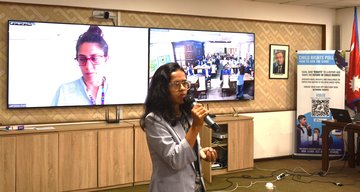
“Addressing harmful social norms, misinformation, and barriers to essential services is critical to improving outcomes—not just in health, but across sectors that shape people’s daily lives,” she said.
Drawing on Nepal’s own progress, Dr. Budhi Setiawan, UNICEF Nepal’s Deputy Representative (OIC) and Chief of Health, highlighted the tangible impact of SBC on national outcomes. “The largest driver in moving immunization coverage from 65 percent to 95 percent was not only supply‑side readiness—it was social and behaviour change, norm shifting, and community engagement,” Dr. Setiawan noted.
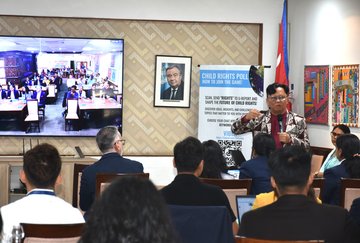
He stressed integrating behavioural data alongside service data in national systems, institutionalizing SBC across all sectoral ministries beyond health, and sustaining investment in community‑level systems.
Understanding Nepal’s Behavioural Challenges
Humberto Jaime, Chief of the SBC Section at UNICEF Nepal, presented eight behavioural challenges shaping development outcomes: harmful social norms, low uptake of essential services, misinformation and mistrust, limited caregiving skills, exclusion and discrimination, low participation and empowerment, unsafe environments and violence, and resistance to climate‑friendly behaviours.
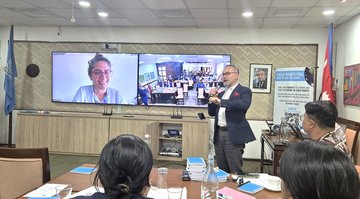
“These are not information problems,” Jaime stressed. “They are long‑term social processes. Sustainable change happens when systems, communities, and norms shift together.”
He noted that the roundtable marked a turning point by creating Nepal’s first national, multi‑sectoral space for SBC collaboration.
Global Perspectives, Local Realities
Connecting Nepal’s journey with global experience, Ms. Neha Kapil, Senior Global SBC Adviser at UNICEF, who joined remotely, outlined emerging trends reshaping SBC worldwide today. “In a post‑truth environment,” she observed, “truth is often shaped by lived experience. What is true for a mother in a remote village may differ from what policymakers believe—and her truth is legitimate.”
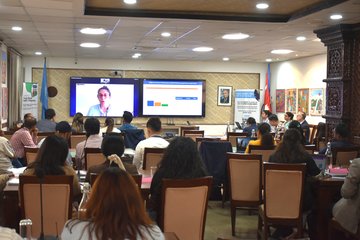
She called for a shift from authority‑based messaging to empathetic dialogue, from short‑term campaigns to embedded community networks, and from individual behaviour change to systems and norm transformation.
SBC in Practice Across Sectors
Concrete examples shared during the roundtable illustrated SBC’s cross‑sectoral relevance. Nutrition and social protection programmes demonstrated how combining financial support with SBC improved dietary diversity and infant feeding practices. Community radios showcased trusted, local‑language platforms enabling two‑way communication and norm change.
Youth networks highlighted sustained climate action driven by peer influence. Academia underscored its role in institutionalizing SBC through curricula, research, and behavioural science centers. Health emergency experiences illustrated how community engagement strengthened trust and improved water purification and hygiene behaviours.
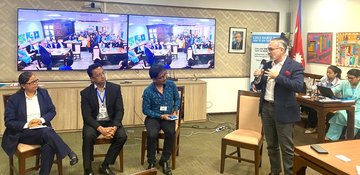
A panel discussion featuring representatives from the Association of International Non‑Governmental Organizations (AIN), the National Disaster Risk Reduction and Management Authority (NDRRMA), and Kathmandu University (KU) focused on cross‑sector collaboration, institutionalization of SBC across systems, and charting a shared path forward for sustained SBC in Nepal.
The roundtable concluded with a shared commitment to establish a national SBC Community of Practice (CoP)— for ongoing knowledge exchange, peer learning, and joint problem‑solving. Participants also agreed to continue the roundtable focused on emerging challenges such as misinformation, digital ecosystems and AI, violence and harmful gender norms, and climate‑linked behaviours.
This first‑of‑its‑kind event marked the beginning of a national collection action, affirming that SBC is central to achieving equitable and lasting outcomes for every child and every community in Nepal.
Special thanks to the NHEICC, NDRRMA, Birgunj Metropolitan City, WFP, ACORAB, AIN, KU, and UNICEF HQ, NCO & FO teams for their trust and contribution!
 Facebook
 X
 LinkedIn
 WhatsApp
 Email
 Copy Link
Average Rating: ☆ ☆ ☆ ☆ ☆ (0 reviews)