


समाचार पोष्ट (अंग्रजीमा): Why Do Essential Services in Nepal Often Go Unused?
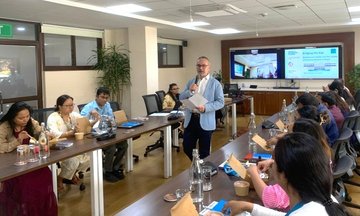
Kathmandu: Why do critical services—from vaccines to education and safe water—often go unused, even when they are available? UNICEF Nepal’s Lunch & Learn session, titled “Bridging the Gap: Behavioural Insights and the Uptake of Essential Services in Nepal” facilitated by the Social and Behaviour Change (SBC) Section last week, brought this question to the forefront, underscoring that access alone does not guarantee uptake.
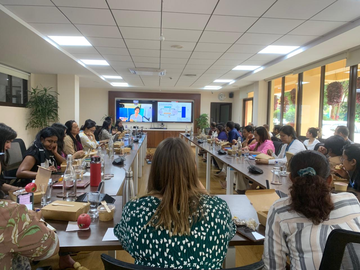
The one-hour session, attended by around 50 participants in person from NCO and remotely by colleagues from Field Offices, highlighted a key SBC insight: people’s decisions are shaped not just by services but by trust, social norms, beliefs, and lived realities.
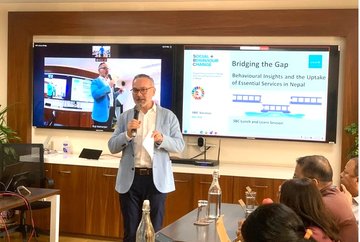
Opening the event, Humberto Jaime, Chief of UNICEF Nepal’s SBC Section, reflected on the behavioural challenges that continue to affect children and families.
"We have identified eight behavioural challenges particularly common to our sectors, including harmful social norms, misinformation and mistrust, exclusion and discrimination, unsafe environments, and resistance to climate‑friendly behaviours.”
Drawing on UNICEF Nepal’s experience, he emphasized that “behaviour is shaped not only by access to services but also by trust, social norms, emotions, and lived realities.”
Turning theory into practice, participants engaged in a simple yet revealing exercise—choosing between chocolates, fruits, notebooks, and pens placed around the room.
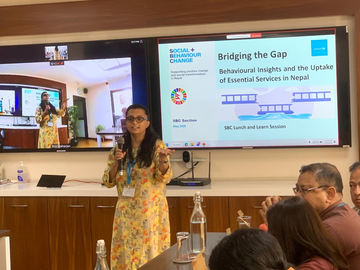
Using the exercise, Akanchhya Aryal, SBC Data for Action Expert, encouraged participants to reflect on what motivates human behaviour.
The activity illustrated a central SBC lesson—decisions are rarely purely rational; they are social, emotional, and contextual.
The discussion was linked to Nepal’s development realities. According to the Nepal Multiple Indicator Cluster Survey (MICS) 2024/25, while access to services has improved significantly, important gaps remain.
Nearly one in five children still miss full immunization, 26.2 per cent of children under five suffer from stunting, and many caregivers lack legal or technical knowledge about birth registration.
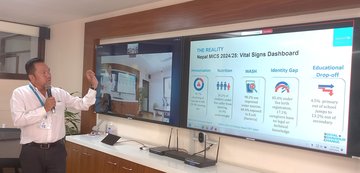
“Improving access is not enough—we must engineer uptake,” emphasized Arun Rai, SBC Specialist (Innovations), pointing to the need for data-driven, behaviour-focused strategies that address trust, misinformation, and systemic barriers.
Real-world examples demonstrated the impact of this approach. Sharing experiences from UNICEF’s Bhairahawa Field Office, SBC Consultant Sajana Kunwar highlighted how, in Lumbini Province, targeted community engagement and trust-building helped reverse hesitancy around HPV vaccination, leading to high vaccine coverage and inclusion of out-of-school girls.
Closing the session, Jaime reinforced a key message:
“SBC is everybody’s business. It is about understanding what drives people to act—not just providing services.”
With monthly learning sessions and continued field innovation, UNICEF Nepal is strengthening its SBC approach to ensure services are not only available but also trusted, accepted, and used—bridging the gap between systems and the people they serve.
 Facebook
 X
 LinkedIn
 WhatsApp
 Email
 Copy Link
Average Rating: ★ ★ ★ ★ ★ (2 reviews)